
Davis Voter Lookup First
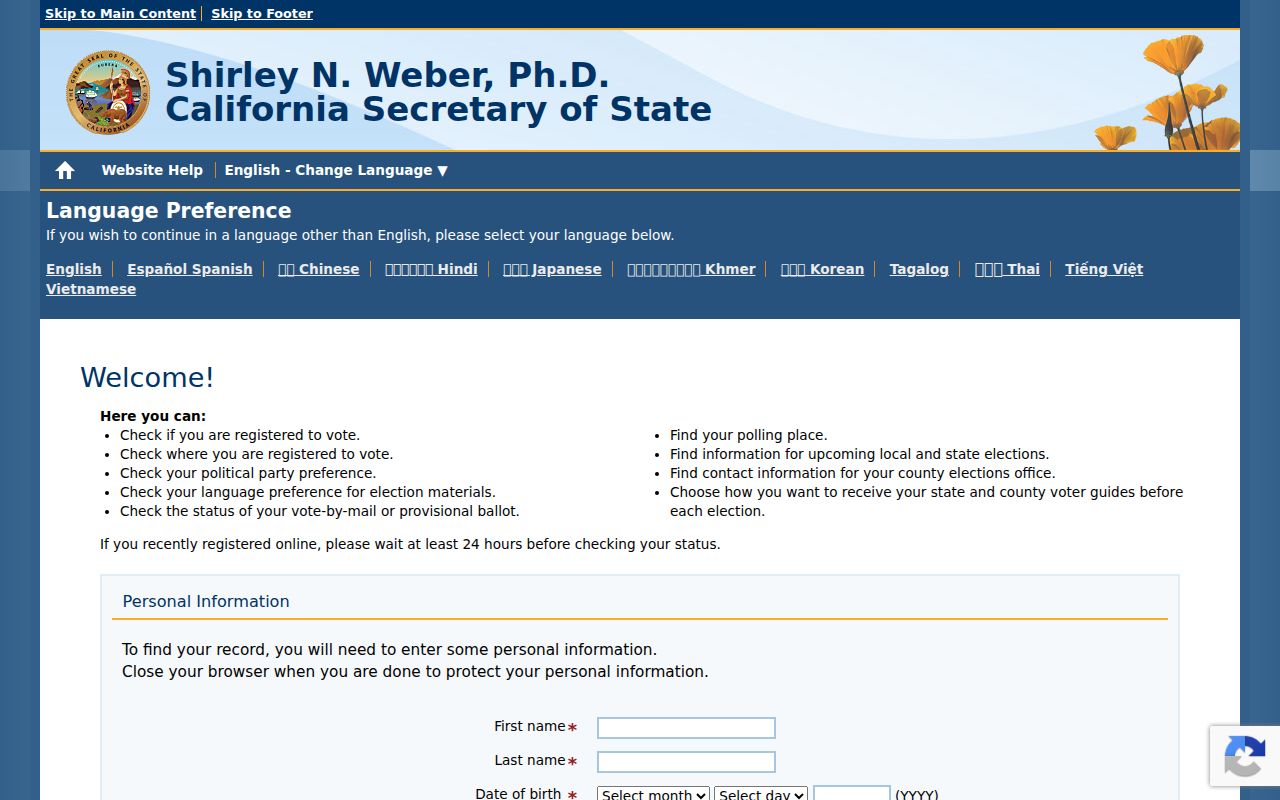
Davis voters use the California Secretary of State's My Voter Status tool for a self-lookup. The official description says it can verify registration status, political party preference, language preference for election materials, vote-by-mail or provisional ballot status, polling place or vote-center information, upcoming elections, and county elections contact. It is meant for the voter, not for browsing all Davis voters by name.
The screenshot below comes from the official California My Voter Status lookup. Because the form is JavaScript-driven, the research captured the official output categories rather than a full static field list.
Safe at Home participants should not use online voter registration workflows and should contact the program instead. That warning matters because protected voter records are handled outside ordinary public data routes.
| Lookup Output | What It Means | Davis Access Note |
|---|---|---|
| Registration status | Whether the voter record is active for election purposes | Self-lookup, not browse-all access |
| Party preference | California party preference on the voter record | Shown through official voter status access |
| Language preference | Election-material language preference where present | Election administration field |
| Vote-by-mail or provisional status | Ballot or provisional tracking information | Election-specific status, not ballot choice |
| Polling place or vote center | Where the voter receives local election service | Depends on current election and county data |
Davis Voter Records Are Controlled
California voter registration records are different from ordinary Davis public records. Access is controlled by Elections Code §§ 2188 and 2194 and state regulations. The data may be provided to authorized applicants for election, scholarly, journalistic, political, or governmental purposes. It is not released as a general personal or commercial directory.
That controlled access rule separates the voter file from open tools such as staff directories, recorder name indexes, or court party searches. A person may confirm their own registration online. An authorized applicant may request data through a formal process. A casual name search of all Davis voters is not an official public web option.
Confidential by law. California withholds driver license and ID numbers, Social Security numbers, HAVA identifiers, signatures, confidential voters, protected voter addresses, and other restricted voter data.
What California Voter Records Show
For authorized voter-file access, California regulations list fields that may appear in voter registration information. The fields can include registration county, unique registration ID, name, residential address, mailing address, phone number, email address, language preference, date of birth, gender, party preference, registration status, registration date, precinct, registration method, place of birth, status reason, voting assistance request status, permanent vote-by-mail status, county voter ID, and voting participation history.
| Name | Available in the authorized voter file, subject to applicant and purpose rules. |
|---|---|
| Residential address | Controlled access only; protected and confidential voters are excluded. |
| Mailing address | Controlled access when included in the record. |
| Party preference | California registers party preference and may include it in authorized data. |
| Registration status and dates | May show status, date, method, and related status reason. |
| Vote history | Shows participation by election date and voting method, never ballot choices. |
| Signature and ID numbers | Not released in the public voter-data request. |
Vote history is often misunderstood. It can show that a person participated in an election and by what voting method. It does not show how that person voted.
Yolo County Voter Data
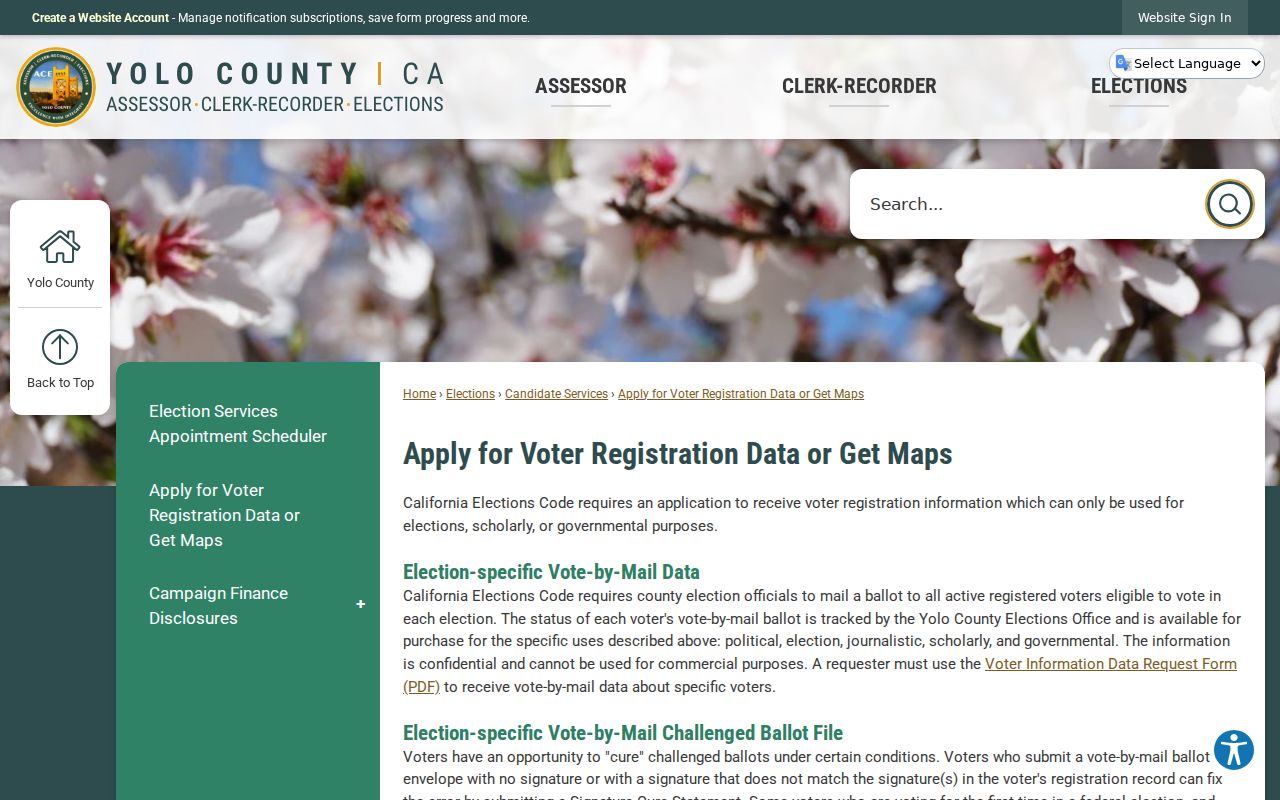
Yolo Elections handles county voter and election data requests for Davis voters. The Yolo voter data request page states that California Elections Code requires an application to receive voter registration information and that the information can only be used for elections, scholarly, or governmental purposes. The same page covers election-specific vote-by-mail data.
The image below shows Yolo's voter and election data request page, the county route for voter-data requests tied to Davis records.
Yolo tracks vote-by-mail ballot status for each voter in an election. The research also notes challenged ballot and cure data with voter contact information, precinct, party, and challenge reason as signature verification and cure statements are processed. That data is election-specific and confidential under the stated access limits.
For Davis voter registration records, the county route is most relevant when the request is tied to a Yolo election, county voter file, vote-by-mail file, challenged ballot file, precinct data, or map. The state route is stronger when the request spans more than one county or asks for the statewide voter file. Either way, the request must state a permitted purpose and protect the data after receipt.
Getting the California Voter File
The statewide voter registration file request goes through the California Secretary of State. The form requires an original signed application, a clear copy of a current driver license or state ID, supporting documentation, payment, and mail or hand delivery to the Elections Division at 1500 11th Street, 5th Floor, Sacramento, CA 95814. Email and fax are not accepted.
- Choose the request type: statewide, county, district, specific voter records, or another defined set.
- Identify the requester type, beneficiary if different, and the permitted purpose.
- Explain the intended use and the security and confidentiality plan.
- Choose inactive records, voting history, precinct-to-district data, and delivery options where available.
- Submit the original signed form, ID copy, support documents, and payment by mail or hand delivery.
| Request | Fee | Delivery |
|---|---|---|
| Statewide, county, or district voter data | $15 per 1,000 records, $15 minimum, $100 maximum | Encrypted DVD in tab-delimited text files |
| Statewide file summary | $100 per SOS page summary | Statewide file delivery rules |
| Specific voter record | $30 per record, $100 maximum, up to 10 records per application | Encrypted WinZip email attachment |
Voter File Application Fields
The California voter-file application asks for more than a name and check. It captures applicant full name, phone, email, business address, mailing address, beneficiary information, requester category, purpose category, intended use, security explanation, data choices, and delivery details. For a specific voter, the form asks for full name, date of birth, county of residence, and residence address.
Processing is listed as 7-14 business days after receipt. The Secretary of State may ask for more information when the details are not enough to identify the voter record. That requirement protects voters from loose, speculative, or unsupported data requests.
Requester categories on the form include political campaign or committee, academic, media, private vendor, legal, governmental, investigation, and other. Purpose choices include California candidate or ballot-measure work, political research, recall, scholarly research, governmental use, initiative or referendum work, record review, and other stated uses. Those labels do not grant access by themselves; they give the election office a way to test whether the request fits California's voter registration rules.
Safe at Home Voter Records
California's Safe at Home program gives eligible participants a substitute mailing address, mail forwarding, agent for service of process, and a confidential voter registration path. It serves eligible survivors and certain threatened public or health-related categories. It does not erase existing public records or hide all identity information.
Confidential voter records under Elections Code §§ 2166, 2166.5, 2166.7, and 2166.8 are not provided to authorized voter-data purchasers. VoteCal guidance in the research says confidential records are available only to staff with proper credentials and are never included in Public Voter Registration Data Requests.
Vote History Is Not Choice
California voter records may include voting participation history by election date and voting method. That field can show whether a voter participated and whether a voting method was recorded. It does not reveal candidate choices, ballot positions, or how a person marked a ballot.
This difference is central to Davis voter registration records. Participation data helps election administration, research, journalism, campaigns, and government work under the permitted-use rules. Ballot secrecy remains separate from the voter file.
Yolo Voter Data Security
Yolo's voter information data request and security form was last modified on February 4, 2026, according to the research. It captures storage and security obligations for voter registration information. Non-confidential datasets such as precinct-district files and maps use a separate form.
Yolo election records also had recent security context. In May 2024, Yolo ACE moved to a .gov domain, citing increased cybersecurity threats to election and local-government infrastructure. In October 2025, Yolo published notices about vote-by-mail processing, ballot drop boxes, vote centers, and a mail theft event affecting several Woodland cluster box units.
Use limits. Voter-registration information may not be used to harass a voter or household, posted insecurely, sent outside the United States unlawfully, or used outside permitted purposes.
California regulations also bar using voter registration information for personal, private, or commercial purposes outside the permitted election-law framework. The research notes that misuse can be a misdemeanor and may carry penalties. For Davis voter records, that means a lawful requester still has duties after access is granted: store the data securely, limit sharing, and use it only for the approved purpose.
Historical Davis Voter Gaps
The research did not confirm exact Yolo or Davis historical poll-book and voter-register holdings in accessible official online text. That gap should not be filled with invented years. For older election or resident work, use Yolo County Archives, California State Archives, UC Davis Special Collections, Davis Enterprise newspaper runs, city directories where held, and county historical collections.
For many Davis family-history questions, older voter records may be less useful than tax assessor rolls, deed books, yearbooks, obituaries, cemetery records, probate files, and local newspapers. Those sources are better documented in the Davis research and should carry the historical trail unless a voter-register holding is confirmed by the archive.